The History of St.
David’s
Episcopal Church…
...the first 25 Years
The basic philosophy of the early mission
and parish was that the church is not buildings.
The church is people, living out their lives
in community, loving God and loving each other,
serving God and each other, joining together
in gratitude to worship and praise God.
In
1954 Bishop McKinstry asked about twelve families
(members in good standing of city parishes)
living in mid-Brandywine Hundred to help start
a mission church. Weekly house meeting began
that July with two initial groups meeting in
the homes of Mr. & Mrs.
Joseph Patterson and Mr. & Mrs. Carl Von
Dreele.
The first four months we discussed the
Church -- Christianity -- what
we wanted and did not want in St. David’s.
Meanwhile a mission building was being constructed
on Grubb Road and the Reverend J. Seymour Flinn
was visiting every existing household in the
area. Among the first mission committee members
were: Joe Patterson, Carl Von Dreele, Gil Loomis,
Betty Harford and Harry Thorogood.
When the
mission opened in November, 1954, the early
members were mostly Arden villagers and members
of the farming community, with a few people
from the fairly-new Carrcroft suburban area.
Most of the people were unchurched or from
a background of other denominations. Our land
was generously given by James Fraser, next-door
neighbor. Facilities consisted of seating for
130 people, a tiny kitchen opening onto a small
parish hall, an office and small classrooms.

The church
was officially dedicated on November 20, 1954
by Bishop Coadjutor Mosley. The processional
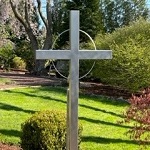
cross, now placed on the aumbry door, had been
sent to Seymour by a cousin in the diplomatic
service in Ethiopia. He bought it in a market
in Addis Ababba, mailed it, and amazingly enough
it arrived in time for the dedication. Carl
and Peter Von Dreele, the only trained
acolytes, participated in the ceremony. James
Von Dreele, eight years old that day, always
felt he received a church for his birthday.
Today he is himself an Episcopal priest.
Regular
services began November 21, 1954. About fifty
adults began regular attendance and Church
School opened with fifty-five pupils and
about a dozen teachers. Joe Patterson was the
first Church School Superintendent.
In the spring
of 1955, Mr. Flinn was ordained to the priesthood
and became Vicar of St. David’s.
At the end of the first year St. David’s
became self-supporting and began exploring
the means of achieving full parish status.
Such an event had not occurred for so long
in the dioceses that no guidelines existed,
so work began from scratch.
There was simplicity
and minimum of tradition in both the worship
and life of the community because many had
never had a church experience. Baptism was
a frequent service. Though it was a period
of expanding birth rate, the majority of
baptisms were adults in those early years.
Confirmation classes were large (mostly adults)
because very few children were old enough.
The
Church School grew to more than 200 children
in a few years and during the second year
of operation it was necessary to have two
services and two church school sessions.
For five years the parish emphasis was education,
for both old and young, and families became
more than nominal Christians. Church School
ran twelve months of the year, superintendents
called on all new families, teachers called
on all new pupils and those absent for more
than three weeks. Concern for each other
was the criterion.
In September, 1955 a Christian
day kindergarten was established under the
direction of Ann Loomis. Ann, Barbara Lamborn
and Ruth Dolmetsch were its first teachers.
There
was no formal choir. A group of a dozen met
weekly and rehearsed the hymns for the following
Sunday to assist in the congregational singing.
Coffee hour afterwards was a joyous time
when members ministered to each other.
By 1956
it was evident that no more children could
be crowded into the little building. A campaign
was sponsored for the purpose of funding added
church school rooms. This was a sacrificial
offering for a year or two on the part of parishioners
-- no new clothes, no new cars!
In September, 1958
headlines read: “St. David’s
Breaks Ground for $100,000 Building” -- our
present parish hall. Seymour Flinn was here for the
ground-breaking, but our recently-married priest
was assigned in the summer of 1959 to Africa to aid
the Anglican Communion in Uganda. The Reverend Harry
Mayfield was called by our vestry from St. Philip’s
Church, Laurel, Delaware in September, 1959. At this
time a rectory, two blocks from the
church, was purchased.
Harry presided
over the new construction. For more than a decade
the new parish hall doubled as a temporary nave
and all-purpose room to accommodate 450 people.
The platform and altar table were moved to
set up for dances, bazaars, benefits, youth
groups, dinners and community service activities.
The new hall more than tripled our usable space.
The Women of the Church transformed the ill-equipped
kitchen into its present degree of efficiency.
Money was raised by annual Fashion Show, Card
Parties…; in later years
from the Country Fairs, events requiring months
of preparation and dedication. At one time
the kitchen was also a lending library and
study center. In 1960 this interim worship
area was connected to the original mission
building by a corridor of four classrooms for
the growing Day School.
Our youth groups swelled.
We experimented with liturgical changes, held
house communions, fold masses and altar dramas.
We welcomed new people into parish life with
greeters, coffee hours, dinners for newcomers
and discussion groups for all. We had three
Sunday morning worship services and yearned
for a “real” church
as we worshipped in our “automobile showroom.” We
were to use the folding chairs from the original
mission for nineteen years!
Harry Mayfield stayed
with us until mid-April 1967, at which time he
accepted a call to St. Mary’s
in Ardmore, Pennsylvania. The four members of
the Rev. David Joslin family moved into the
rectory temporarily. David was installed as our
third rector on October 29, 1967. Since David
chose to accept a housing allowance, the rectory
was sold and his family moved into their own
home in Lancashire. David came from St. Paul’s
Church in Montvale, New Jersey where he had been
assistant rector. In 1969, the Rev. John
E. Keene, Executive Director of the Episcopal
Church Home Foundation, was elected as a part-time
priest assistant.
After much scrutiny of plans
and costs, the vestry in April, 1969 approved
a mortgage of $260,000 offered by Delaware
Trust Company for the construction of our nave.
The work was awarded to Haddock Construction
Company. The ground-breaking ceremony was held
May 4, 1969, with the late Bishop William H.
Mead officiating. Some of the articles placed
in the cornerstone are a cross, a prayer book,
a Bible, parish list (1969) and a newspaper
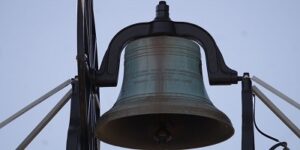
of the day. St. Thomas’ Church
in Newark gave us the tower bell from their original
building, and on the 31st of May in 1970 our new
sanctuary was dedicated.
An appointed committee
coordinated the furnishings. This committee
selected the design and fabric for the nave’s
cathedral chairs, the antiques in the nave
and sanctuary, the carpeting, and the Oriental
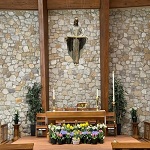
rug in the area of the altar. Sculptor Charles
Parks gave us his ‘Christus Rex’ of
iron which is over the entrance to the nave.
An antique pulpit from Immanuel-on-the-Green,
New Castle was restored and presented by
the descendants of the original donors. Vestments
and frontals for our altar were given as
memorials. In 1974 we were finally able to
purchase the Allen Electronic Organ.
Since
its beginning St. David’s has sought
to serve the community. Holy Child Roman Catholic
Church used our facilities several days a week
during their building period. Boy Scouts,
the Opera Society, Recovery, and Alcoholics
Anonymous are organizations which have met
here regularly. We have revamped and retained
our kindergarten and Day School programs
to meet a growing community need -- a non-denominational
day care center presently numbering 150 children,
forty of whom receive day care and lunches.
In
March, 1974 David Joslin accepted a call
to become Rector of Christ Church, Westerly,
Rhode Island. John Keene served as priest-in-charge
until the fall of 1974 when he moved to Memphis,
Tennessee. Nearly a year elapsed before our
vestry called the Rev. David Tontonoz from
Trinity Church, Milford, Massachusetts. Our
church hosted the Diocesan Convention that
elected Bishop William H. Clark in January,
1975.
Father David’s
family of five settled in Lancashire. Much of our
life and worship continued along established
patterns with various innovations by Father
David. Tweny-five years after our start, we
had a family service at 9:00 a.m. with communion,
giving our children exposure to a full worship
service.
While no longer
preoccupied with expansion of membership
and buildings, we sought inner growth
and depth for ourselves. Probably the most
intensive effort in this direction was the
Faith Alive Weekend held in October, 1975.
Small prayer groups continued to meet and prayer
vigils were held on special occasions.
An evening group met weekly to study the
Bible, and The Holy Eucharist and Ministry
of Healing services on Wednesday mornings were
followed by Bible Study.
Of equal magnitude was our sponsorship
of a Vietnamese family, the Nuygens, who
lived for some months with Alan and Sue Miller
until they were able to have their own home.
St. Davidians gave of themselves and their
resources until this family was launched in
a new homeland.
A number of new furnishings
were added. Perhaps the major one was
the sculpture of Christ above the altar. It,
too, is by Charles Parks and serves as a focal
point to the whole interior.
Father David
had two priest assistants -- the Rev.
John Edmonds and the Very Rev. Edward Harris.
John worked with the chaplain at Delaware
State Hospital and left us in September of
1977 to continue his training in Kansas City.
Our priest assistant, Father Harris,
was formerly dean of Philadelphia Divinity
School and co-dean of Episcopal Theological
Seminary, Cambridge, Massachusetts. He
functioned essentially as his predecessors.
Our
parish life continued to vary according to
the people and the times. Traditions were now
a part of our yearly calendar - Lenten Food
Closet for those less fortunate than we, Maundy
Thursday Seder Meal followed by the Lord’s
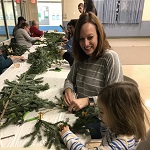
Supper, Advent wreath-making and Evensong (including
the Adopt-a-Family project for those in need), and
St. David’s Day (March1) confirmation service.
Worship was epitomized by the Christmas and Easter
Festival Eucharists. Other annual events included
vestry weekends at Memorial House and confirmation
class weekends at Camp Arrowhead. A beautiful memorial
Garden was begun -- a joyful
addition as well as a burial ground for ashes.
No “history” can
capture all the facets of a constantly changing
community of people and activities. Current
members of St. David’s
are indeed indebted to our predecessors who gave
so unselfishly of their time and energy, bringing
us to our present stage of growth -- Wardens and
Vestries, Altar Guilds, Memorial Committees,
Church School teachers, choir members, lay
readers, Women of the Church, and above all,
the contributions of dedicated individuals.
Each person who has worked and worshipped in
St. David’s will have experienced a unique
aspect.
HOME
| DAY
SCHOOL | CHILDREN
| YOUTH
PRAYER & WORSHIP
| MUSIC
CLERGY
& STAFF | OUTREACH
HISTORY:
1954 to 2004

2320 Grubb Road,
Wilmington, DE 19810 -- Call (302) 475-4688.
Member Congregation of The Episcopal
Diocese of Delaware.
in The Episcopal Church of the USA
To send us e-mail,
Copyright
2000-2007, Saint David's Episcopal Church, Wilmington,
Delaware
|